
Grandmaster Albert Cheeks: The Champion the World Knew — and the Uncle His Family Loved

Updated: Aug 16

A BLXCR Tribute
There are champions remembered for the trophies they won, the medals they wore, and the opponents they defeated. Then there are those whose greatest victories cannot be placed inside a trophy case.
Grandmaster Albert Cheeks was both.
BLXCR extends our deepest condolences to the family, friends, students, and all those whose lives were touched by Grandmaster Albert Cheeks. His passing represents the loss of a respected martial artist, teacher, spiritual leader, mentor, and family man whose influence reached far beyond competition.

His name holds an important place in American Taekwondo history. A senior black belt under the late Grandmaster Ki Whang Kim, Brother Cheeks became known as a formidable heavyweight tournament competitor. In 1973, he represented the United States at the inaugural World Taekwondo Championships in Seoul, South Korea, where the American team earned a silver medal and Brother Cheeks earned an individual bronze.
Those accomplishments tell us something about the competitor.
His niece, Sister Kimarie Muhammad, tells us about the man.
Before She Knew the Legend, She Knew Her Uncle
Long before Sister Kimarie understood what the words Grandmaster or Hall of Fame meant, Albert Cheeks was simply the uncle she admired.
From a child's perspective, she remembers a man who seemed larger than life.
“He was like our little hero in the family,” she recalled.
At Thanksgiving dinners, family reunions, and other gatherings, Brother Cheeks was often the person who spoke to the family and offered the prayer. His leadership was not something Sister Kimarie learned about later from an article or biography. She witnessed it growing up.
Then there were the trophies.
Sister Kimarie was raised in her grandmother's home, where Brother Cheeks' martial arts trophies seemed to be everywhere. Some, she remembered, were so tall they nearly touched the ceiling.
Only later did she discover something remarkable: those weren't even all of them.
As a child, she knew her uncle practiced martial arts and kept winning. She saw the evidence every time another trophy entered the family home. What she did not yet understand was the magnitude of what he was accomplishing.
“I didn't really realize how popular he was,” she said. “For a long time, I didn't even know he was in the Hall of Fame.”
That may be one of the most revealing parts of his story.
The world could call him Grandmaster Albert Cheeks. His family could simply call him Uncle.
A Champion Beyond the Ring
Brother Cheeks' influence extended beyond martial arts.
Sister Kimarie remembers him as an entrepreneur who seemed determined to create his own path. She recalled that he was a manager at The Clubhouse, a gathering place in the Georgia Avenue and Upshur Street area of Washington, D.C. It became part of the family's memories as well—a place connected to performances, celebrations, weddings, and community gatherings.
“I never saw him work for anybody,” she recalled. “Everything that he set out to do, or said this is what I want to do, he did it.”
But as the years passed, another side of her uncle became even more important to her: his spirituality.
Brother Cheeks became someone she could call when she needed guidance—whether the issue was personal, spiritual, or simply one of life's difficult moments. The discipline that had helped make him a champion in martial arts became wisdom he could pass to others.
For Sister Kimarie, that wisdom would eventually become connected to her own mission.
“Don't Give Up. Keep Going.”
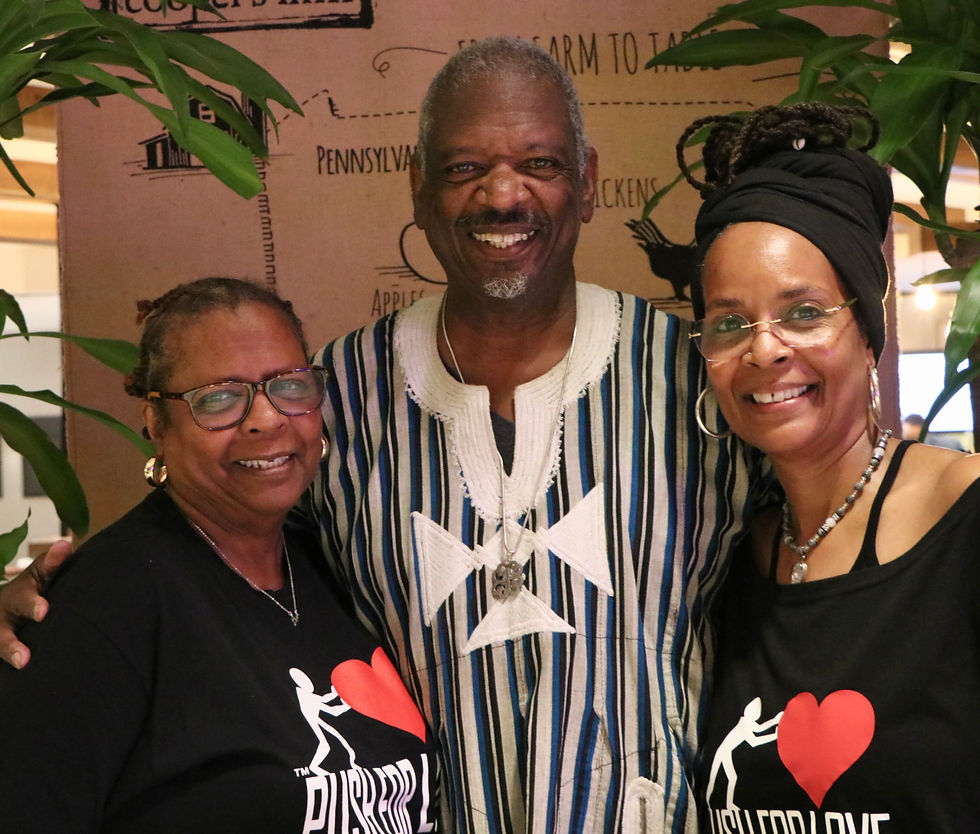
When Sister Kimarie began developing Push for Love, a movement built around love, community, caregivers, families, healing, and support, one of the people she called was her uncle.
She told him about the idea and her desire to eventually place the message on shirts and develop something larger around it.
His response stayed with her:
“You got something, Kim. Don't give up. Keep going. It will eventually catch on.”
Those words became more than encouragement.
They became an anchor.
When Sister Kimarie later decided to turn Push for Love into a nonprofit, Brother Cheeks again offered his support. He told his niece that if there was anything he could do to assist her, she only needed to ask.
And when she needed a major speaker for her retreats, she called him.
He came.

At those gatherings, the legendary martial artist wasn't there simply to discuss championships. He spoke about life, perseverance, discipline, spirituality, and the mental strength required to push through difficult circumstances.
That message fit naturally with what Push for Love was trying to accomplish.
Sister Kimarie's work is deeply personal. Her experiences raising her son, Jabrill, who has cerebral palsy and special needs, helped her understand why caregivers and families need community. Push for Love became a way of creating some of that community—bringing people together while incorporating forms of wellness and natural therapy such as breathing exercises, meditation, massage, sound therapy, and other approaches to reducing stress.
Building something like that, however, has not always been easy.
There have been moments when Sister Kimarie questioned whether she could continue. Organizing events, raising money, absorbing financial losses, and carrying much of the responsibility herself could become exhausting.
During those moments, she still hears her uncle.
Don't give up. Keep going.

“I hear his voice,” she said.
And she keeps moving.
That may ultimately be one of Grandmaster Cheeks' greatest victories—not simply what he accomplished himself, but what he convinced someone else was possible.
One Last Ride Together
Sister Kimarie's most emotional memories came near the end of her uncle's life.
On July 16, following the funeral of Brother Cheeks' brother, circumstances placed Sister Kimarie and her uncle alone together for a drive to the repast in Upper Marlboro.
At the time, she had no idea how precious that ride would become.
Brother Cheeks was already experiencing considerable physical pain and needed a walker. Yet inside the car, for a little while, niece and uncle could simply talk and laugh.
He spoke to her about the special relationship she shared with her son. He encouraged her to finish her book because he believed other families could learn from her experiences raising a child with special needs.
“Make sure you finish your book,” she remembers him telling her. “Other people need to hear your story.”
He still had things he wanted to accomplish himself. There were stories he wanted to tell and work he hoped to finish.
Even while dealing with his own difficulties, he was still encouraging someone else.
When they arrived at the repast, Sister Kimarie helped him make his way inside. It was an extremely hot day, and the short journey from the vehicle into the building became difficult because of his pain. She remembers trying to make him comfortable, getting him into the shade, finding him something cold to drink, and even using humor to make a challenging moment a little easier.
But another moment was still waiting for them.

As they were leaving, a woman who did not know them saw Sister Kimarie standing with her uncle and sister.
The woman stopped them.
She told them they looked beautiful together and offered to take their picture.
Sister Kimarie handed over her phone. Several photographs were taken.
At the time, it seemed like a simple act of kindness from a stranger.
Today, it means something entirely different.
That photograph became one of Sister Kimarie's final pictures with her uncle.
Looking back, she sees the moment through her faith. What appeared accidental then now feels divinely arranged.
She believes Allah allowed her one final opportunity to have her uncle to herself—to laugh with him, listen to him, serve him, help him through his pain, hear his wisdom once more, and then leave with a photograph that would preserve the memory.
“I didn't know that was going to be the last time I was going to see him,” she said.
That ordinary car ride had become a gift.
More Than Medals
I had the opportunity myself to hear Grandmaster Albert Cheeks speak at a Push for Love gathering and to record and interview him.
What stood out was not a man consumed with his own accomplishments.
It was his warmth.
There was compassion in the way he shared his wisdom. His experiences gave weight to his words, but he did not need his achievements to dominate the room. He could speak about perseverance because he had lived it. He could speak about discipline because he had practiced it. And he could speak about pushing through adversity because his life gave him stories worth telling.
That is why stories like this deserve to be preserved.
Too often, we wait until our elders and legends are gone before we discover how much history was sitting right beside us. We recognize trophies, championships, titles, and Hall of Fame honors, but sometimes overlook the quieter contributions—the phone call, the prayer at Thanksgiving, the advice given to a niece, the encouragement offered to a struggling caregiver, or the decision to stand before a room and give someone hope.
Brother Cheeks' medals matter.
His championships matter.
His place in Taekwondo history matters.
But so does a niece hearing her uncle's voice in her mind when she feels like quitting:
Keep going. Don't give up.
That is legacy.
Sister Kimarie was also present during one of the most difficult moments a family can experience—the final moments of her uncle's physical life. Yet even through grief, she chooses to view his journey spiritually.
She knows she will miss him. She also believes his presence does not simply disappear because his physical life has ended.
“He will never be forgotten,” she said.
Remember the Man Behind the Legend
At BLXCR, we believe honoring our legends means doing more than reporting that they have passed.
It means asking who they were while they were here.
Who did they encourage?
Who did they teach?
Who became stronger because they crossed paths with them?
Who is still carrying something they said?
For Grandmaster Albert Cheeks, those answers stretch from the martial arts community to the church, from his students and fellow champions to his family, and from international competition all the way back to a little girl staring at trophies that seemed to touch her grandmother's ceiling.
That little girl eventually grew up and started a movement of her own.
And when the work became difficult, the champion who once stood inside the ring continued fighting alongside her—not with his hands, but with four simple words:
Don't give up. Keep going.
Grandmaster Albert Cheeks leaves behind medals, championships, history, students, family, faith, wisdom, and memories.
But perhaps the greatest measurement of a champion is not how many people remember what he won.
It is how many people continue moving forward because he once told them they could.
Rest in honor, Grandmaster Albert Cheeks.
From BLXCR and the community we serve, we extend our deepest condolences to the Cheeks family, Sister Kimarie Muhammad, his students, loved ones, and everyone blessed to have learned from his life.


Comments