
Something Good Can Come Out of Ward 8 Washington DC


CREWS brings residents, organizers, faith leaders and community partners together for service, recognition and a vision for transformation
BLXCR Community Report
“Something good can come out of Ward 8.”
Those words captured the spirit of a tenant appreciation gathering at the Vista, where residents, seniors, children, organizers, volunteers and community partners came together with CREWS — Communities Respecting Everyone’s Will to Survive.

Brother Edward Tate opened the program in good spirits and with high energy, immediately establishing the focal point of the day: the mission of CREWS and its commitment to community development and transformation.
Speaking before an appreciative audience of Vista tenants, Brother Tate made it clear that the gathering was more than a celebration. It was an opportunity for residents to understand who CREWS is, why the organization had come into the community and how its ministries and partnerships could become resources for the people who live there.
Brother Tate emphasized that CREWS was created around the idea that organizations and individuals with different skills can work collectively instead of attempting to solve deeply rooted community problems alone. Its mission is to establish a united front capable of addressing the needs of the whole community—from children and teenagers to mothers, fathers, adults and seniors.
That message set the tone for everything that followed.
Rather than spending the day simply discussing what is wrong in the community, Brother Tate and the CREWS team challenged those present to consider a different question:
What are we prepared to build together?

Prayer Before the Program
The gathering began in a spirit of prayer and unity.
Children were brought toward the center while seniors and elders who needed to remain seated were encouraged to stay comfortable. Residents joined hands as prayers were offered for the young, the elderly, families, volunteers, staff and those working throughout the community.

The prayer called for protection over the Vista and the surrounding Ward 8 community and recognized those who had come to serve, including brothers from the Nation of Islam.
A second prayer focused specifically on CREWS and the sacrifices required to do community work.
Members had given up Saturdays, weekends and portions of their summers to organize, plan and serve. The prayer acknowledged everyone who participated, donated or supported the effort, including those unable to attend.
At the center of those words was the meaning behind the organization’s name: Communities Respecting Everyone’s Will to Survive.
As those gathered were reminded, everyone has a survival story.
Community Development Starts With Relationships

CREWS representatives explained that their work does not begin by walking into a neighborhood and telling residents what they need.
It begins with relationships.
When CREWS learned of an opportunity to work with the Vista, organizers first connected with tenant leadership. Those conversations eventually included property management because the organization believes community development works best when residents, management and community partners understand the mission and work together.
Management was thanked for welcoming the collaboration, while donors and sponsors were recognized for helping make the tenant appreciation gathering possible.
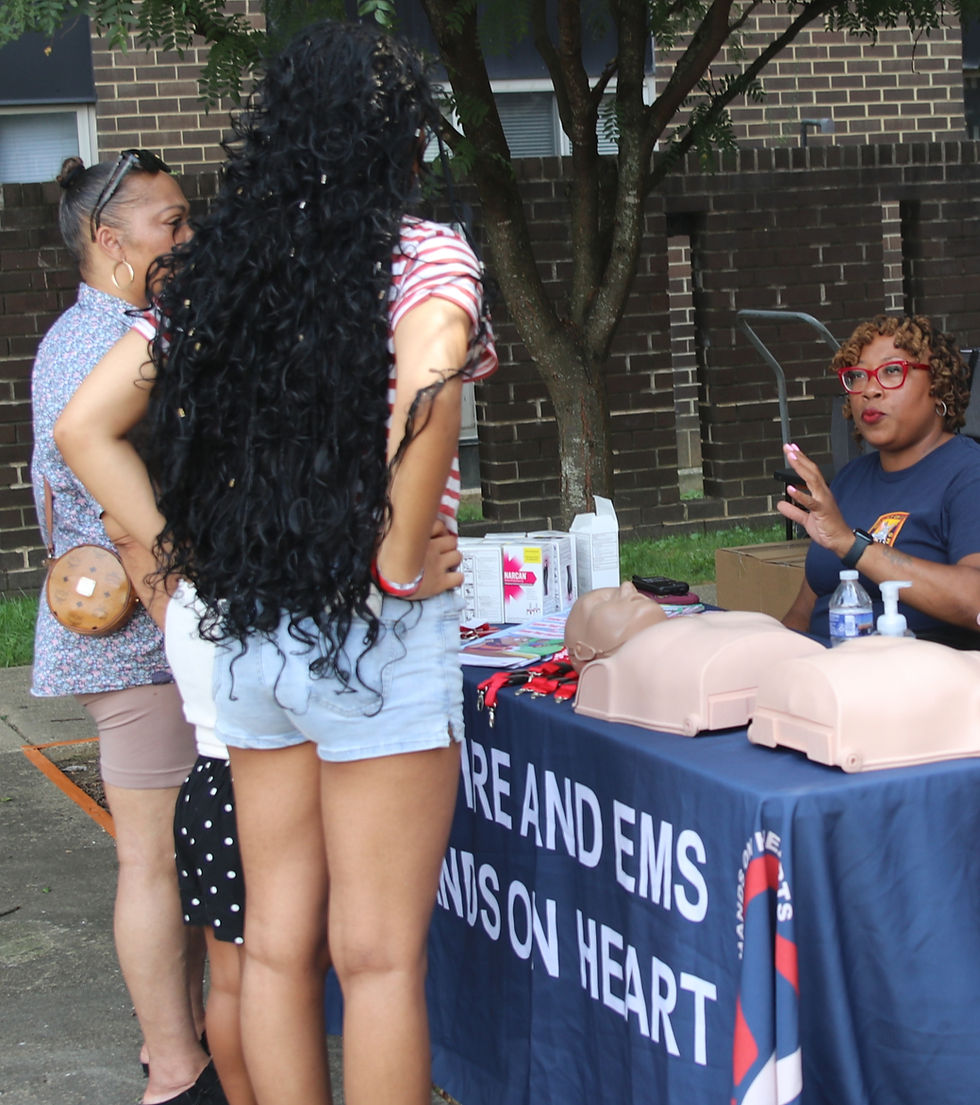
Special appreciation was extended to the Leadership Council for Healthy Communities, which has worked with CREWS through care management and outreach.
Organizers repeatedly emphasized that CREWS cannot transform a neighborhood by itself.
The organization is attempting to create a structure where people and organizations with different skills can work toward common objectives rather than operating separately.
Educators may bring education. Health advocates may address health. Tradespeople can teach vocational skills. Organizers can organize. Mentors can mentor.
But residents must also have a place at the table.
CREWS made clear that people living in the communities being served must participate in their own development.
From Problems to Solutions
One of the day’s strongest messages addressed a habit familiar in many struggling communities: people becoming extremely knowledgeable about everything that is wrong while spending far less time organizing around solutions.
“We must move from reacting to problems to building solutions.”
Generational problems involving violence, addiction, poverty, family instability, incarceration and educational disparities did not develop overnight. CREWS argued that breaking those cycles requires more than another temporary program.
It requires changes in thinking, behavior and relationships.

That can begin with something small: speak to your neighbor, check on the elderly, know the young people living around you and care about what happens outside your own apartment or home.
Community revitalization cannot simply be delivered from the outside.
It has to be developed from within.
Mothers: Strengthening the Foundation

Sister Terry Acker, a mother of five, introduced the Motherhood Ministry, describing an effort designed to create sisterhood, leadership and support among mothers.
A question posed during the presentation went directly to the heart of the ministry:
“How can a community heal without first healing the mother?”
The vision goes beyond parenting classes. CREWS wants mothers supporting other mothers and developing the confidence and skills to become stronger leaders in their households and neighborhoods.
The presentation also carried a personal message for those fortunate enough to still have their mothers in their lives: appreciate them, respect them and, where relationships have been damaged and reconciliation is possible, seek peace.
Fathers: Breaking the Cycle of Absence

Brother Randall Gilbert, representing the Relentless Fathers Army, followed with a testimony rooted in his own childhood.
Brother Gilbert was raised by a single mother and never knew his father.
“He could walk into this place right now and I would not know him.”
Instead of repeating that experience, Gilbert made a decision before his own children were born: they would know what it meant to have their father present.
He described a father through four images: a foundation supporting the family, a wall offering protection, a lighthouse providing direction and a runway preparing children to soar into adulthood.
Even after children take off, he explained, the runway remains available when they need to return for guidance or “refueling.”
“Fathering is not a race. It is a journey.”
The ministry’s commitment is equally direct: no father gets left behind.
Life Skills and the Power of Education

Brother Reginald Howard, a licensed minister, Washingtonian and educator, presented the Life Skills Ministry.
Its focus includes literacy, reading comprehension, writing, résumé development and preparing people to pursue employment.
Brother Howard connected literacy to something much larger than getting a job.
Education can become a tool of liberation.
“What you put in your mind, no one can take it out.”
He challenged the idea that children struggling academically should be treated as future candidates for incarceration.
“We don’t need to be in cell blocks.”
Instead, communities should intervene with knowledge, skills, expectations and opportunities that give young people another direction.
Food, Clothing and Addiction Outreach

The practical side of CREWS’ work was represented by Brother Amedeo Hines and Sister Nicole through the Food and Clothing Distribution Ministry.
Clothing was made available to residents through the CREWS community boutique, while Brother Hines discussed his commitment to making sure usable food reaches people rather than being discarded.
His outreach extends to shelters, people experiencing homelessness and individuals affected by addiction.
Brother Hines spoke openly about the opioid crisis and acknowledged that addiction had touched his own life. That experience now helps drive his desire to reach people who are still struggling.
Narcan was available at the gathering, along with information for those wanting conversations about recovery and other resources.
Sister Nicole explained the philosophy behind the work:
“We come to the community not just to be a part of it, but to be one—to unite.”
Whether someone has experienced a fire, is going through a difficult transition or needs food, clothing or another service, the objective is to connect that person with help.
Experience Turned Into Advocacy
Brother Michael Henson offered another example of how lived experience can become a community resource.
Henson told residents that he spent 32 years in the streets and has spent the past 27 years on the other side, working with organizations committed to helping people.
His philosophy is simple: nobody should be left behind.
Henson also discussed advocating for a Black men’s health clinic. When told that clinics already existed, he challenged whether those facilities were actually providing the kind of access and services needed by the population he was talking about.
When funding was raised as a barrier, his response was solution-oriented: if the money is not currently available, teach the community how to pursue it.
Before Serving the Youth, Listen to Them

Brother Nate, representing Message in the Music during the youth-development portion, challenged community organizations to examine how they approach young people.
Programs can have logos, slogans and good intentions, he explained, but none of that replaces understanding what young people actually need.
“There’s a lot of us going out that are giving what we think people need.”
His recommendation was to conduct a genuine needs analysis—talk to young people, listen to them and understand their world before deciding what should be offered.
“We got to meet them where they are.”

Brother Nate also challenged the constant negative portrayal of youth.
Young people possess ideas, creativity and gifts that adults may overlook. Effective youth development should identify that potential rather than treating young people only as problems requiring correction.
Agriculture, Vocational Skills and Self-Sufficiency

Brother Chris Ross spoke about agriculture and vocational development.
“Agriculture is the basic foundation of our survival. Everybody got to eat.”
His presentation connected agriculture with greater control over food and vocational development with the ability to build and maintain community infrastructure.
Trades and apprenticeship programs can provide young people with practical pathways toward meaningful careers while developing skills that communities themselves need.
The broader principle was independence.
Communities cannot spend generation after generation waiting for someone else to arrive with a solution.
The Youth Are More Than the Problems We See

During remarks on community relations and outreach, Sister Jani reflected on organizing efforts connected to the Panthers of DC and the challenge of finding enough committed people willing to work around youth safety, street outreach and missing children.
She described eventually connecting with CREWS and finding partners willing to support ideas she had struggled to advance alone.
Her remarks also invoked the legacy of Dr. Khalid Abdul Muhammad and the Million Youth March, connecting that history with present concerns involving educational inequality, economic exclusion, the school-to-prison pipeline, mass incarceration, community violence and cultural erasure.
But she refused to define young people solely by those conditions.
Inside them, she reminded the audience, are brilliance, genius, creativity and resilience.
The challenge is creating an environment where those qualities have room to grow.
Tyrone Parker: “Me, We”

Community elder and mentor Tyrone Parker brought the audience back to collective responsibility through the spirit of Muhammad Ali.
Parker recalled the famous two-word expression:
“Me, We.”
For Parker, those words represented what community work should look like. Individual strength has value, but its greatest impact comes when it contributes to the whole.
He reflected on Ali’s struggles, sacrifice and ability to encourage others before leaving the gathering with a simple hope:
“May we stay together and love each other and build our great community.”
Brother Reginald Howard reinforced the message with scripture:
“Behold, how good and pleasant it is for brethren to dwell together in unity.”
Accountability Goes Both Ways
As the program moved toward the Tenant Appreciation Awards, Floyd Mays of the Leadership Council for Healthy Communities thanked residents for supporting the work and encouraged those with unmet needs to identify themselves so organizations could better connect them with services.

Community Manager Sister Crystal Riggins was then presented with a Certificate of Appreciation recognizing her cooperation and commitment to Vista residents.
Sister Riggins accepted the recognition but also offered an important challenge.
“We are a community.”
Families and communities require structure, she explained, and people already face enough barriers without creating unnecessary divisions among themselves.
She encouraged residents to embrace CREWS and use the services being offered.
Then she turned the responsibility back toward the organization.
She expected CREWS to stand behind what it promised the community and deliver.
That moment was important because genuine partnership requires accountability in both directions.
Residents must participate. Organizations must produce.
Giving the Tenants Their Flowers

Sister Bernadine Smith was recognized for her leadership, persistence and dedication to the Vista. Organizers described her affectionately as someone who gets things done and refuses to accept excuses when work needs to be completed.
Then came the residents themselves.
Doris Boatwright was honored as Adult Tenant of the Year.
Roosevelt Branding and Virginia Willis were recognized as Senior Tenants of the Year.
Joslynn Vallare was recognized among the tenant honorees representing the community’s younger generation.
For the longtime residents receiving recognition, the moment was about more than a certificate. It acknowledged people who have lived through the community’s changes and remain part of its foundation.
Virginia Willis spoke warmly about her many years there and expressed gratitude for the community, its leadership and the Tenant Association.
Service Without Seeking Recognition
The program also honored members of the CREWS team whose work helped make the gathering possible.

Sister Jani Earle received recognition for going beyond the call of duty, including spending seven- and eight-hour days preparing fish to feed Vista residents.

Then Brother Amedeo Hines was unexpectedly called forward.
Earlier, Brother Hines had spoken about addiction, outreach, food, clothing and serving people experiencing hardship. Now the community was recognizing his own contribution.
His response explained why the recognition surprised him:
“This is not why I do what I do. I do what I do because I love what I do.”
Hines spoke about where he came from, the experiences that shaped him and his gratitude for being able to serve.
He described himself as a humble servant to the community.
The Work Begins After the Celebration

The formal program eventually gave way to food, fellowship, vendors and entertainment, including an edutainment presentation connected with Message in the Music.

Vista residents were intentionally given first preference for the food.
It was, after all, their appreciation day.
But perhaps the most important measure of the gathering will come after the chairs are folded, the food is gone and the awards have been taken home.

CREWS presented an ambitious model: strengthen families, listen to young people, support mothers and fathers, educate residents, address addiction and health, develop vocational skills, encourage food independence and bring organizations together around shared solutions.

Now comes the harder part—turning that vision into consistent action.
Sister Crystal Riggins’ challenge to CREWS may ultimately become one of the most important statements of the day: deliver what you promised.

CREWS issued an equally important challenge to residents: become participants in your own community’s development.
Those responsibilities meet in the middle.
That is where transformation has a chance to begin.
Not with one organization. Not with one leader. Not with one event.
But with people recognizing that their individual survival is connected to the survival of the community around them.
Or, as Tyrone Parker reminded everyone through the words associated with Muhammad Ali:
“Me, We.”
And perhaps that is what the Vista gathering ultimately demonstrated:
Something good can come out of Ward 8.
The question now is how much more can be built when the community decides to build it together.


Comments